Showing posts with label Alfa Romeo. Show all posts

Wednesday, January 19, 2011

Daihatsu, Alfa Romeo and Mercedes Top Vehicle Ownership Satisfaction Study in Germany

For the first time since the launch of the study in 2002, Daihatsu has claimed the top spot in J.D. Power and Associates' redesigned 2009 Vehicle Ownership Satisfaction Study (VOSS) in Germany with a total score of 843 on a 1,000-point scale. The Japanese brand was followed by Alfa Romeo and Mercedes-Benz that tied in second place with 835 points, BMW was third with 834 points and Audi and Toyota that tied in fifth place with 831 points.

On the other side of the scale, Ford (796 points), Opel, Kia and Peugeot that tied with 790 points, Fiat (778 points), Chevrolet (775 points) and Smart (772 points) occupied the last five places in J.D. Power's 2009 German vehicle ownership satisfaction study. The industry average is 814 points.

Model-wise, Daihatsu's Sirion captured the top rank position in the small car category while Toyota received awards for the Aygo city car and the Corolla lower medium car. In the upper medium segment, Renault's Laguna finished first while Mercedes-Benz topped the executive / luxury and sports car segments with the E-Class and CLK Class models respectively.

Also receiving segment-level awards are the Skoda Roomster in the MPV group and the Nissan Qashqai in the SUV category.

J.D. Power and Associates' finding are based on 16,200 online interviews with German vehicle owners after an average of two years of ownership. According to the firm, German owners are asked to provide detailed evaluations on their cars and dealers covering 67 attributes grouped in four measurements of satisfaction including: vehicle appeal (32%) which covers performance, design, comfort and features; vehicle quality and reliability (26%); ownership costs (22%) including fuel consumption, insurance and costs of service/repair; and dealer service satisfaction (20%).


2010 Alfa Romeo Sports Car Bertone Pandion Concept

Bertone returns to the Geneva Motor Show 2010, after a two year absence from the international scene, unveiling a concept car that makes its world premiere here: the Pandion, an aggressive yet beautiful coupĂ© designed as a tribute to Alfa Romeos’ one hundred year anniversary. The Alfa Romeo Pandion Concept: an extreme and controversial sports car in typical Bertone fashion. The size of the concept car (4620 mm in length, 1971 mm wide, 1230 mm high, 2850 mm wheelbase) offers a compact sports car external dimensions with a large sports car interior feeling. Bertone Pandion Design Sketchoffers a compact sports car external dimensions with a large sports car interior feeling, all powered by a 4.7 litre, 450 CV 8-cylinder Alfa Romeo engine.
2010 Alfa Romeo Sports Car Bertone Pandion Concept
The name comes from the animal world, as Pandion Haliaetus is the scientific name for an Osprey: a sea hawk that nests and lives in coastal areas. The designers, led by Mike Robinson, have drawn inspiration from the wings of this predator to invent the spectacular door opening mechanisms, and from the hawks' facial markings to project the traditional Alfa family feeling into the next era of design.
2010 Alfa Romeo Sports Car Bertone Pandion Concept
The designers, led by Mike Robinson, have drawn inspiration from the wings of this predator to invent the spectacular door opening mechanisms, and from the hawks’ facial markings to project the traditional Alfa family feeling into the next era of design. In almost a century of Bertone tradition, it is not the first time that natural wonders have inspired the names of concept cars. Just think of the Corvair Testudo (1963) and, by no coincidence, the Alfa Romeo Canguro (1964), Carabo (1968) and Delfino (1983).
2010 Alfa Romeo Sports Car Bertone Pandion Concept
The Pandion’s taut and muscular body is the result of an original interpretation of the Alfa Romeo badge, where the man-eating snake depicted there represents the attraction of elegance (what we call the ‘Skin’), and the aristocratic cross symbolises the rigour of rational thought, the technological aspect (what we call the ‘Frame’).
2010 Alfa Romeo Sports Car Bertone Pandion Concept
According to this interpretation, the Pandion’s design is, like every Alfa Romeo, a perfect synthesis between ‘Skin and Frame’, an ideal balance resulting from a tension between opposites: technology and sensuality, rationality and instinct, architecture and sculpture, structuralism and organicism, industrial excellence and excellent craftsmanship.
2010 Alfa Romeo Sports Car Bertone Pandion Concept
The design of the Pandion is based on a concept Robinson calls: "Skin & Frame” - a new interpretation of the inherent duality in the 100 year old Alfa Romeo logo. “Skin” refers to the snake in the logo, representing the world renowned Italian excellence in beautiful, seductive forms; and “Frame” refers to the cross in the logo, representing the mechanical excellence in high performance Italian race cars. The combination of the two has now become a dynamic dial searching for an ideal balance resulting from the tension between opposites: technology and sensuality, rational and emotional, architectural layout and sculptural form, structural and organic, industrial excellence and artisan excellence.
2010 Alfa Romeo Sports Car Bertone Pandion Concept
According to this interpretation, the vibrant energy in every Alfa Romeo is represented by Pandions’ spinal structure (or ‘Frame’), which crosses the length of the car from the V-shaped grille in the nose of the car to the V-shaped bumper in the tail of the car, crossing the interior as a visually aesthetic structural element which supports the surrounding shell (or ‘Skin’).
2010 Alfa Romeo Sports Car Bertone Pandion Concept
The Alfa Romeo Pandion Concept has the profile of a true sports car, with no room for compromise. The architectural layout is 'cab rearward', meaning the passenger compartment is positioned towards the rear of the car and the long bonnet pushes the car's visual centre rearward. The body side visually connects the sensuous front end with the razor-edged rear by means of an extremely long flowing side window which stretches from front wheel arch to rear, enhancing the excellent accessibility of this low-bodied sports coupé.
2010 Alfa Romeo Sports Car Bertone Pandion Concept
Since sports cars are traditionally difficult to get in and out of, this important ergonomic activity has been facilitated with an extra wide door opening to make up for the low roofline. This new graphic formula not only adds a striking new visual division between the upper and lower parts of the body, but it also offers an incredible panorama window for passengers inside. The strong diagonal dark-light division in the rear of the side view accentuates the powerful rear wheel drive layout and draws special attention to the hidden door opening mechanism.

Tuesday, January 18, 2011

Fiat Group Seals Mirafiori Deal with Unions, Marchionne Criticizes Nay-Sayers


Fiat Group CEO Sergio Marchionne’s key productivity deal won narrow backing from workers of the historic Mirafiori plant in Turin, with 54% of them voting in favor of the groundbreaking contract that limits strikes and absenteeism in exchange for investment.

The agreement enables the automaker to start building Jeep models in Italy and it’s also considered as a crucial step in Alfa Romeo’s U.S. launch. The deal was fiercely contested by a more hard-line Italian union, which threatened the deal with strikes. Fiat said last week that it’s ready to pull out altogether from the country if an understanding is not reached.

However, the positive outcome means that Fiat and Chrysler can go ahead with their €1 billion euro ($1.32 billion) joint-venture, with 60% of the investment to be covered by Fiat which wants to build around 150,000 Alfa models a year at the plant. Chrysler will provide the rest in order to get an annual quota of about 100,000 units of the next generation Jeep Compass/Patriot, due to launch in 2013.

Aside from being the catalyst for further development, the new labor contract was also necessary if the Fiat Group was to improve its productivity.

In 2009, Mirafiori workers built 178,000 cars, less than a third of the 600,000 vehicles their Polish counterparts of the Tychy plant managed, with both factories employing roughly the same number of workers. That means productivity at Mirafiori averaged 30 cars per employee a year, compared with almost 100 at Tychy.

It’s clear that this is “an industrial scheme which needs to be reformed”, said Gianluca Spina, dean of the business school at Milan's Polytechnic, before the referendum result was announced.

While Fiat Chairman John Elkann said that “controversies and contrasting positions” have to be put aside and future challenges faced in “a constructive manner”, CEO Sergio Marchionne issued a much more aggressive statement, heavily criticizing the opposing union. The full statement is available below.


Statement from Fiat CEO, Sergio Marchionne

We are pleased that the majority of workers at Mirafiori have understood Fiat’s commitment to transform that plant into one of international standing. We are pleased because their vote demonstrates their confidence in themselves and their future.

They have chosen not only to say “yes” to a new opportunity for Mirafiori, the opportunity to work and compete with the best. They have also chosen to take their destiny into their own hands, to take an historic step and become the architects of something new and important.

In a country such as Italy, which has always been tied to the past and reluctant to change – and yesterday’s referendum was in part a demonstration of that – those who voted yes showed vision.

Their vote represents a desire to achieve rather than being resigned to decline. It represents a courage to overcome the inaction of those who just talk and expect things to happen.

I have always been extremely proud of what Mirafiori represents for Fiat, of its role as custodian of our Group’s and our nation’s industrial heritage, and of the capability it has always demonstrated.

Mirafiori and those who work there did not give up when, in 2004, many were predicting the plant would close. Together we brought the plant back from the brink of despair, giving it back its dignity and future.

The majority of our workers have not allowed themselves to be conditioned by the many accusations and attacks of those that sought to gamble with their future. They have chosen instead to commit themselves, to dedicate their abilities and passion to making a difference. This is the best response to the lies and provocations of recent months.

By saying “yes” to the agreement, they have closed the door on extremism, that creates nothing but chaos, and they have opened the door to the future, to the privilege of transforming Mirafiori into a factory of excellence.

I hope that those who voted no, putting aside their ideologies and preconceived notions, will realize the importance of the agreement in safeguarding the future of all workers.

The plan for the Mirafiori plant is very ambitious. The company to be created in partnership between Fiat and Chrysler will enable establishment of a new platform at Mirafiori for the construction of large SUVs for distribution under both the Jeep and Alfa Romeo brands worldwide, including in the United States. This will allow us to achieve very high production levels, of up to 280,000 vehicles per year, and also open the way for the potential creation of jobs.The sole purpose of the agreement that serves as the basis for achieving all of this – the same agreement that has been at the center of so much conflict – is to ensure the plant works more effectively, without infringing on any rights.

It doesn’t penalize workers in any way. Rather, it maintains unchanged all conditions of the national collective agreement which are in their favor, as well as all those conditions which Fiat has over time extended to its workers directly. The work organization is, in fact, the same that has been experimented with at Mirafiori for more than 2 years and takes account of the level of fatigue associated with the type of work performed. The introduction of 18 shifts includes a Saturday evening shift which is the most problematic. Accordingly, it has been agreed that, even though workers are still compensated, it will only be activated if there is a real need and, in any case, will be treated as overtime. Full utilization of the 18 shifts would also enable an increase in annual pay of around €3,500 per year.

We have also taken account of other needs relating to overtime. As employees cannot always be available, we have instituted the option of substituting up to 20% of those workers who are unable to work overtime. By revising the system of breaks, reducing them to 30 minutes and monetizing the difference, we have also brought ourselves into line with standard practice at factories throughout the rest of Europe and the world. For sick leave, in relation to which many absurd things have been said, the agreement simply provides for monitoring of the rate of absenteeism, to avoid potential abuse. A commission operated jointly with trade unions will evaluate, on an individual basis, cases where the company is not liable to cover absences.

The purpose of this clause is to call attention to the problem, by provoking individual conscience and sense of responsibility, and I hope that it is never invoked.

Finally, we have simplified the compensation structure which will make pay-slips easier to read and also have a positive effect in the case of overtime or shift work, with supplements being applied to basic pay, which is higher than current minimum contractual values.

As the majority of our workers have understood, there is nothing exceptional in the Mirafiori agreement, other than the opportunity to relaunch the plant and give it the profile it deserves internationally. The criticisms leveled at us have been unjust and often frustrating. When you see your efforts being misrepresented, you sometimes ask yourself if it is really worth it.

The majority of workers at Mirafiori have given the clear message that commitment to building something better is always worthwhile.

Saturday, January 15, 2011

Fiat’s Future in Italy Could be at Stake Due to Disagreements with Unions


As previously reported, Fiat hasn’t been able to secure agreements with all Italian unions regarding a key productivity deal to help the automaker to keep its turnaround strategy on track. With a hard-line union planning a strike later this month, the country’s Prime Minister Silvio Berlusconi claims Fiat will have a good reason to quit Italy if the deal falls through.

Fiat CEO Sergio Marchionne agreed with Mr. Berlusconi saying that the future of the company in Italy could be at stake and he might be forced to move all production to lower-cost countries.

The dispute with the FIOM union, which represents workers employed at Fiat’s historic Mirafiori plant, concerns the introduction of more shifts and reduced benefits. The automaker supports that implementing these changes is crucial if the company is to make further investments and build new models in Italy.

Talking with reporters in Berlin after a meeting with German Chancellor Angela Merkel, Silvio Berlusconi commented: “We think that what has been happening in this case is absolutely positive, with the possibility of an accord between the unions and the company, in the direction of greater flexibility”.

“It's obvious that if this didn't happen, clearly the company and business people would have a good reason to move to other countries. Let us hope this has a positive outcome”, Berlusconi added.

Source: Reuters

Find of the Day: Alfa Romeo 8C Competizione Spider for $310,000


Found hidden amongst a bunch of used, older generation Alfa Romeo models in Autotrader's used car listings, is this extremely rare 8C Competizione Spider. The 450HP V8 Italian exotic has been put up for sale by Connecticut-based Miller Motorcars, with the dealer stating it is a one-owner example driven a mere 825 miles since new and that it's one of 20 cars made for the U.S. market out of a total run of 500 examples (we must note that to our knowledge, Alfa Romeo built 35 Spiders for the USA).

The dealer adds that the original sticker was $328,477, with the price of this white-colored example set at $310,000. So what do you say; is this Ferrari/ Maserati-derived, Alfa Romeo-badged exotic worth its price tag or would you look elsewhere if you were lucky enough to have this kind of cash laying around in your bank account?

Source: Autotrader via VWvortex

Monday, January 10, 2011

2010 Pininfarina Alfa Romeo Sports Car Spider Concept

Pininfarina, an Italian car design studio, has released to the public the teaser image of their new Alfa Romeo concept. Pininfarina turns 80 years-old this year. As part of celebrating this important milestone the company will unveil this two-seater spider concept pictured here at the 2010 Geneva Motor Show in March. It will be presented as a tribute to its long relationship with Alfa Romeo. The unveiling coincides with Alfa's 100th anniversary so it is doubly fitting. The design has been managed by Lowie Vermeersch, head of Pininfarina’s style centre, and the rear reflects the old Alfa Romeo Duetto model, with its cuttlefish-bone inspiration.
2010 Pininfarina Alfa Romeo Spider Concept
A revival of the Alfa Duetto is an exciting proposition, and the prototype will be the same two-seater Spider vehicle. It will have a longitudinal engine placed in the front and rear-wheel drive. No production plan has been established as yet, so we can’t say if this could be an eventual replacement to the current Alfa Spider.
2010 Pininfarina Alfa Romeo Spider Concept
Apart from the obvious not much else is said or revealed about the car. But from this solitary sketch it can be noted that the current 8C Spider has some serious styling competition. The long sloping bonnet, two-door configuration and short rear overhangs are the main signs of a classic roadster. Whether this traditionalist approach will be kept intact with a soft folding roof remains to be seen.
2010 Pininfarina Alfa Romeo Spider Concept
Perhaps the Pininfarina/Alfa Romeo relationship is about to receive a new life. Hopefully the concept is as good, or even better than this sketch suggests.

Alfa Romeo Shows Concept Designer Bags Inspired by MiTo


In what could be seen by many as further proof that Alfa Romeo is steadily losing sight of its core values (whatever is left of them, that is...), the firm's UK division unveiled two concept designer bags for its MiTo subcompact as part of the company’s centenary year celebrations and to help support young British fashion talent. We might be wrong, but we think it would have been more appropriate for the Italian firm to show its support to young British car designers...

In any case, for the creation of the bags, Alfa Romeo UK held a special competition for students from the MA Fashion course at Central Saint Martins College, London. A total of 15 graduates submitted sketches inspired by the MiTo for initial consideration, but only two made the cut.

"After being critiqued and judged by some of the leading faces in British fashion, the bags created by CSM students William Hendry and Tamara Elliot were chosen for the limited run," said Alfa Romeo UK in a statement.

According to the Italian firm, the two bags are prototype designs for Alfa Romeo UK, which is now looking to produce a limited range of both in the near future.

Wednesday, January 5, 2011

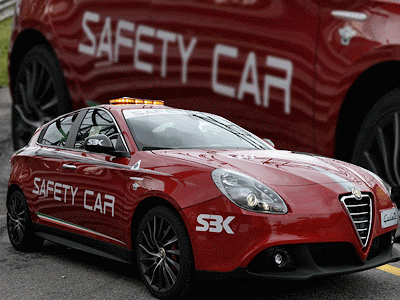
2010 Alfa Romeo Sports Car Giulietta Safety Car

The 2010 World Superbike races at Monza saw the debut of the new Alfa Romeo Safety Car in the SBK World Championship: a Giulietta Quadrifoglio Verde equipped with a powerful 235 HP 1750 TBi engine. The New Alfa Romeo Giulietta enter the track as a safety car in the World Superbike Championship, which between the Place inschrijving 22 and 23 May this year.
2010 Giulietta Safety Car Alfa Romeo Sports Car
The 2010 Safety Car Alfa Romeo Giulietta will come with a exterieur schilderen Rosso Competizione, that THIS beschikbaar Only Be Special Editions, and the Kleur was removed from the pallet beschikbaar because they had problems with the supplier. The Red Rosso Competizione Kleur beschikbaar NEWLY be back in November, when the Be Back Kleur beschikbaar for Gama.
The new Safety Car, which was also on display in the paddock presented by TV star Elenoire Casalegno, completed a lap of the track together with a fascinating Alfa Romeo 8C Competizione machine. The 8C supercar forms part of Alfa Romeo's new design and technology course, which also includes the MiTo model and now the new Giulietta.
As a reminder, Alfa Romeo, is one of the main sponsors of motorsport competition, which is also a member of the Ducati Xerox Team riders: Noriyuki Haga and Michel Fabrizio. On the occasion of his role as the safety car, the Alfa Romeo Giulietta few laps at the circuit of Monza for exotic 8C Competizione, the Italian car brand Halo.
Italian sports car brand versions use Giulietta, Quadrifoglio Verde good for 235 hp. 2010 Safety Car Alfa Romeo Giulietta is powered by 1.75-liter gasoline engine, and TBI was specially prepared for the role of the safety car in 13 degrees, which are left from this year's Superbike World Championship. Alfa Romeo Giulietta is also engaged in the promotion race and Superstock 600 European Championship Superstock 1000 FIM Cup and World Supersport.
Prepared especially for the 23rd edition of World Superbike, the Alfa Romeo Giulietta safety car features a set of aerodynamic accessories and the Rosso Competitzione exterior colour, and the car is expected to offer assistance until the end of the season.
Bearing the Quadrifoglio Verde (Green Cloverleaf) logo, which has a prestigious racing history on circuits throughout the world, the powerful Alfa Romeo Giulietta has been prepared specifically to carry out its task as Safety Car for the 23rd edition of the Superbike World Championship.
2010 Safety Car Alfa Romeo Giulietta has a spoiler and special thresholds that will be available to order from the catalog Lineaccessori. The side mirrors are made of carbon fiber. Superbike World Championship will be a red Giulietta Giulietta customers come to look forward to November. This is because the Alfa Romeo Competizione Rosso paint removed from the directory because of problems with one supplier.

Sunday, January 2, 2011

Poll: Should Fiat Cut Loose Alfa Romeo and/or Sell it to Volkswagen?


Like Saab and countless other brands before, Alfa Romeo is at a tipping point. The famed Italian automaker, which once stunned the world with its gorgeous styling and motorsport victories, is now losing an estimate €200 million (US$265 million) per annum. It’s hard to believe that the company that brought us cars like the GTA, the Spider and the 158/159 Alfetta could be reduced to such a sad state of affairs.

Sergio Marchionne, the unwavering CEO of Fiat and its subsidiaries, is determined to turn the ailing automaker around. Meanwhile, Volkswagen is sniffing around for more brands and smells a potential winner in the Milanese company.

There are many arguments for and against selling Alfa Romeo to ze Germans. Here are the ones we’ve covered in our previous article:

The Case For Selling Alfa Romeo

  • Alfa Romeo is valued at €1.5 to 2 billion. By selling what equates to their biggest loser, Fiat would emerge virtually debt free.
  • The brand’s dismissal would save Fiat a further €1.5 billion that it would of spent product R&D over the next four years.
  • Fiat would also save €200 million a year in losses.
  • Alfa’s departure could potentially allow for Dodge to return to Europe as Fiat’s sporty brand, with Fiat remaining the first choice for entry level buyers and Lancia / Chrysler for those seeking something a little more upmarket.
  • Volkswagen has worked wonders with Bentley, Seat and Bugatti. Can you think of a better mother hen for one of Italy’s finest?

The Case Against Selling Alfa Romeo

  • If Fiat can survive until 2014, analysts predict it will emerge with no debt and fatter profit margins. And that’s with Alfa Romeo.
  • Fiat could net the same amount of lira by selling three of its OEM suppliers: Magneti Marelli, Comau and Teksid.
  • After Fiat’s expected 2014 recovery, the Milanese automaker is expected to account for 10% of Fiat’s sales.
  • Fiat has plans to share platforms between Alfa Romeo, Chrysler and Jeep, helping all three brands. Without the platform sharing, Chrysler and Jeep will continue struggle and Fiat’s push into the Chinese and Russian markets will be delayed.
  • With Fiat focusing primarily on small cars, it would have to develop new mid-sized and large car models to fill the gap left by the departing Alfa.

So there you have it: five points for and five points against. All that’s left now is to cast your vote, so get voting!

Saturday, December 25, 2010

Analyst Forecasts New Chrysler and Fiat Models Until 2012 Including Jeep based Alfa GTX SUV

Research firm IHS Global Insight (GI) has released a new analysis forecasting a variety of Chrysler and Fiat Group models to be built in North America between 2011 and 2012. Before we say anything else, we'd advise to pay attention to the words 'analysis' and 'forecast'. That said, don't take everything you read as a fact. The report begins with the Alfa Romeo 169, a BMW 5-Series rival that is said to be built at Chrysler's Ontario factory in Canada with the first models rolling off the assembly line as early as November 2011.

The analyst predicts that the 169 will be based on Chrysler's LX platform which underpins the Chrysler 300 and Dodge Charger models. While it makes sense for the Italians to use the LX platform, unless Fiat is planning to simply re-skin / re-mask the next-generation Chrysler 300 into an Alfa, in which case, we're talking about a mistake from Fiat's behalf, saying that that the Alfa Romeo 169 will be ready to enter production in about two years time, is quite optimistic. Plus, as you can see in one of Fiat's previous product plans, Alfa was supposedly scheduling to introduce a self-developed 169 in 2009 - what happened to that?

Talking about the LX platform, the forecaster said that due to the bankruptcy of Chrysler LLC and the plant closures, the start of production of the new 2011 Dodge Charger and Chrysler 300 have been delayed to November 2010 and January 2011 respectively.

Continuing with the North American-built Fiat models, Global Insight said that the highly successful in Europe, 500 mini, will be made in Toluca, Mexico with U.S. sales starting in July 2011.

The MINI-rivaling 500 will be the only Fiat-badged model to be sold in the States. Since the 500 is based on Fiat's 169 platform, the Toluca plant will also produce the Jeep Panda 4x4, again from July 2011. We're guessing that the Jeep variant will most likely be a remasked version of the European market Panda 4x4.

Next up we have an array of models based on the Fiat Group's C-EVO platform that underpins C-segment cars like the Lancia Delta and Fiat Bravo. The report says that the C-EVO will be used on the next-generation Dodge Journey crossover, Dodge Caliber crossover and Chrysler Sebring sedan. Production is slated to begin for the Journey and Caliber in July 2012 at the Belvidere Assembly Plant, and for the Sebring, in June 2011 at the Toluca assembly plant.

In addition to the above models, the C-EVO platform is also reported to form the base for an Alfa Romeo compact SUV (no date) and weirdly enough, for the successor of the Jeep Liberty (July 2012) with both SUVs said to be produced at the Toledo plant in Ohio.

But the report gets even better as it is predicted that Fiat will produce a larger Alfa Romeo SUV model called the GTX at Chrysler's Jefferson North Assembly Plant beginning in July 2011. The GTX is said to be based on Jeep's WL platform that underpins the 2011 Grand Cherokee. However, bear in mind that the Grand Cherokee's WL platform is derived from Mercedes-Benz (it was developed during Daimler's reign over the company) so we're not entirely sure if Fiat has the rights to use the platform for one of its own models.

The paper ends with two subcompact hatches, the Dodge Hornet and Alfa Romeo MiTo that will share the same hardware- aka Fiat's 199 B-segment platform. Both cars are reported to be built for the American market at Chrysler's Belvidere assembly plant in Illinois with production slated to begin in March 2011 for the Hornet and July 2011 for the MiTo.

Call us skeptics, but if you want our opinion, we find the forecast extremely optimistic in the sense that Fiat will not only have to develop, design, engineer and test a whole bunch of new cars but also revamp Chrysler's North American factories to build the vehicles and all this in just two years from now.

 
coompax-digital magazine